As a gym owner in New Jersey, you know that your equipment is the lifeblood of your business. It’s what attracts members, keeps them safe, and drives your revenue. But when a treadmill grinds to a halt or a cable machine snaps, you face a critical decision: should you repair or replace it? This isn’t just a maintenance question—it’s a financial one that can significantly impact your bottom line.
Making the right call in the repair vs. replace gym equipment dilemma requires a strategic approach, not a gut reaction. This guide will walk you through the key factors to consider, helping you make a cost-effective choice that keeps your facility running smoothly and your members happy.
Key Factors in the Repair vs. Replace Decision
Don’t let a single breakdown force you into a hasty and expensive purchase. Before you decide, evaluate the situation by weighing these essential factors.
1. The 50% Rule: Repair Cost vs. Replacement Cost
A widely accepted guideline in asset management is the 50% rule. If the cost of a repair exceeds 50% of the cost of a new, comparable piece of equipment, replacement is almost always the more sensible option.
For example, a high-end commercial treadmill might cost $10,000 new. If a major repair, like replacing the motor and deck, is quoted at $6,000, you are well past the 50% threshold. Investing that money into a brand-new machine with a full warranty is a smarter long-term investment. However, if a simple console replacement costs $800, repairing it is clearly the better financial choice.
2. Equipment Age and Lifespan
Every piece of gym equipment has an expected lifespan. While commercial-grade machines are built for durability, they don’t last forever.
- Cardio Equipment (Treadmills, Ellipticals): Typically lasts 7-10 years with regular maintenance.
- Strength Machines (Selectorized, Plate-Loaded): Can last 10+ years, though cables and upholstery will need periodic replacement.
- Free Weights (Dumbbells, Barbells): Can last a lifetime, but may require cosmetic refurbishment.
If a 9-year-old treadmill that has seen heavy daily use suffers a major failure, it’s likely nearing the end of its useful life. Sinking significant money into it is a gamble, as other components are likely to fail soon. Conversely, a 3-year-old machine with a faulty part is an excellent candidate for repair.
3. Frequency and History of Breakdowns
Is this the first time this machine has broken down, or is it a regular occupant of your “Out of Order” sign collection? Keep a maintenance log for each piece of equipment. A machine that needs constant attention is a drain on your resources.
- Pros of Repairing a First-Time Failure: Often a simple, one-off fix that restores the machine to full function.
- Cons of Repairing a Chronic Problem: You end up paying for a series of small repairs that can quickly add up to more than the cost of a replacement. These “death by a thousand cuts” scenarios also create a poor member experience due to unreliable equipment.
4. Safety Concerns
Safety is non-negotiable. If a repair cannot guarantee the equipment will be 100% safe for your members, you must replace it. Issues involving frayed cables, cracked frames, or malfunctioning safety stops pose a significant liability risk.
Even if a repair seems possible, consider the long-term implications. A “patched-up” frame on a squat rack might hold for now, but the potential for catastrophic failure is too high. In these cases, the decision is made for you—replacement is the only responsible option.
5. Warranty Status
Always check the warranty before making a decision. Many manufacturers offer extensive warranties on commercial equipment, sometimes covering the frame for a lifetime and parts for several years. If the machine is still under warranty, the repair might be free or heavily subsidized, making it the obvious choice.
Once the warranty expires, you bear the full cost of parts and labor. This is when a careful cost-benefit analysis becomes crucial.
Commercial Gym vs. Home Gym: Different Scenarios, Different Rules
The repair vs. replace gym equipment debate plays out differently in a commercial setting compared to a home gym.
For the Commercial Gym Owner
Your equipment is a commercial asset that must generate a return on investment. Downtime equals lost revenue and member dissatisfaction.
- Appearance and Technology: In a competitive market like New Jersey, having modern, sleek equipment can be a deciding factor for potential members. An old, repeatedly repaired machine can make your entire facility look dated. Replacing it can be a marketing move as much as a maintenance one.
- Usage Volume: Commercial equipment endures thousands of hours of use per year. Wear and tear are accelerated, making major component failure more likely. This high usage justifies investing in durable, easily serviceable machines.
- Expert Advice: As a gym owner, your expertise is in fitness and business management, not necessarily equipment mechanics. Relying on a professional technician’s diagnosis is crucial. A trusted expert can tell you if a repair will provide a lasting solution or if you’re just putting a temporary bandage on a fatal wound.
For the Home Gym User
For a home gym, the decision is more personal and less tied to revenue.
- Cost Sensitivity: Home gym users are typically more budget-conscious. A $500 repair for a treadmill that cost $1,500 is a significant expense, making repair a more attractive initial option.
- Usage Volume: A home treadmill might see 5-10 hours of use per week, compared to 50-70 hours for its commercial counterpart. This lower usage means even less durable machines can last longer, and repairs are more likely to hold up over time.
- Downtime Tolerance: If a home elliptical is out of commission for a week while waiting for a part, it’s an inconvenience. In a commercial gym, it’s a business problem.
Your Action Plan: Making the Final Call
When faced with a broken machine, follow these steps:
- Isolate the Issue: Place an “Out of Order” sign on the equipment immediately to ensure member safety.
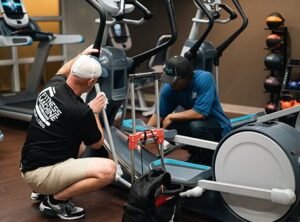
- Call a Professional: Contact a certified gym equipment repair technician for a full diagnosis and a detailed quote. Don’t guess what’s wrong.
- Gather the Facts: Ask the technician for the cost of parts and labor. Separately, research the price of a new, comparable model.
- Review Your Records: Check your maintenance logs for the equipment’s age and repair history. Check its warranty status.
- Do the Math: Apply the 50% rule. Consider the “soft costs” of frequent breakdowns, such as member complaints and damage to your gym’s reputation.
- Make an Informed Decision: Weigh all the factors—cost, age, safety, and business impact—to choose the path that makes the most financial sense for your facility.
Don’t Guess, Get a Professional Assessment
Navigating the repair vs. replace gym equipment question can be complex, but you don’t have to do it alone. Making the wrong choice can cost you thousands in the long run, either through overspending on a new machine or wasting money on a piece of equipment that’s beyond saving.
The team at NJ Fitness Equipment Repair provides expert, unbiased assessments for gym owners across New Jersey. We can diagnose the problem accurately, provide a transparent quote, and give you the professional advice you need to make a smart financial decision. Before you commit to a costly replacement, let us see if a professional repair can get your machine back in the game safely and affordably.
Contact us today to schedule an inspection and keep your gym in peak condition.