Managing a commercial gym in New Jersey involves more than just keeping the lights on and the membership rolls full. As a facility owner or manager, you shoulder a massive responsibility: ensuring the physical safety of everyone who walks through your doors. A single malfunction on a treadmill or a snapped cable on a weight stack can lead to serious injury, costly lawsuits, and irreparable damage to your brand’s reputation.
Understanding and adhering to gym equipment safety standards isn’t just about ticking boxes on a checklist. It is about creating a culture of safety that protects your members and your business. When you prioritize rigorous maintenance and professional repairs, you aren’t just fixing machines—you are insulating your business against liability.
This guide breaks down the essential safety protocols, inspection routines, and liability considerations that every New Jersey gym owner needs to master.
The Foundation of Gym Equipment Safety Basics
Gym equipment is subjected to intense, repetitive stress daily. Unlike home gym gear used occasionally by one person, commercial equipment faces hundreds of hours of use every month. This heavy traffic accelerates wear and tear, making safety standards a moving target that requires constant vigilance.
At its core, gym equipment safety revolves around three pillars: structural integrity, mechanical functionality, and user instruction.
Structural Integrity
Every piece of equipment must remain solid and stable. This means bolts shouldn’t wiggle, frames shouldn’t flex where they aren’t supposed to, and welds must remain intact. Even a hairline fracture in a steel frame can lead to a catastrophic failure under a heavy load.
Mechanical Functionality
Moving parts are the most likely failure points. Cables, pulleys, belts, and bearings must operate smoothly. Friction is the enemy here. If a machine feels “gritty” or makes unusual noises, it is signaling a potential safety hazard.
User Instruction and Warning Labels
Safety standards also extend to how users interact with the machines. Are the warning labels legible? Are the instructions for use clear? In many liability cases, the argument isn’t just that the machine broke, but that the user wasn’t adequately warned about the risks or instructed on proper usage.
Establishing rigorous Inspection Routines
You cannot fix what you don’t know is broken. A reactive approach—waiting for a machine to break before fixing it—is a recipe for negligence claims. To meet high gym equipment safety standards, you need a proactive, tiered inspection routine.
The Daily Walk-Through
Your floor staff should perform visual checks every single day. This doesn’t need to be a deep mechanical dive, but a general sweep to catch obvious issues.
- Check for loose debris: ensure no personal items or trash are stuck in treadmills or weight stacks.
- Listen for noise: turn on cardio equipment to check for grinding or squeaking sounds.
- Visual cable check: glance at cables on strength machines for fraying or stripped coating.
- Upholstery check: tears in pads can expose foam or sharp staples, which are safety hazards.
The Weekly Deep Dive
Once a week, a more thorough inspection is necessary. This should be documented in a maintenance log.
- Tighten hardware: Check nuts and bolts on all benches and racks. Vibration loosens these over time.
- Test emergency stops: Physically test the emergency kill cords and stop buttons on all treadmills. If they don’t work instantly, the machine must be marked “Out of Order” immediately.
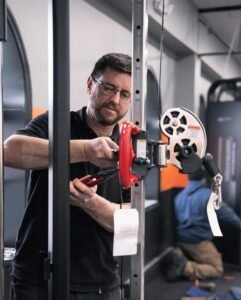
- Cable tension: Check that cables on selectorized machines are properly tensioned. A loose cable can slip off a pulley, causing a weight stack to drop unexpectedly.
The Quarterly Professional Audit
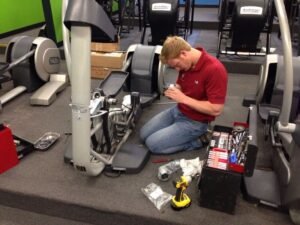
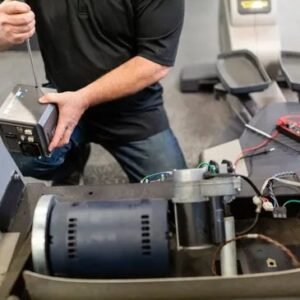
Even with diligent staff, you need expert eyes on your equipment. Professional technicians can spot internal wear on motors, invisible fatigue in cables, and electronic issues that laypeople will miss. Scheduling a quarterly preventive maintenance visit with a certified repair service is the gold standard for compliance.
Understanding Liability Risks in New Jersey
New Jersey is a litigious environment for business owners. When a member gets hurt in your gym, the first question legal counsel will ask is: “Was this preventable?”
If an injury occurs because a user dropped a weight on their own foot due to poor form, that is often considered an inherent risk of exercise. However, if an injury occurs because a cable snapped, a treadmill surged speed unexpectedly, or a bench collapsed, the liability shifts squarely to the facility owner.
Negligence vs. Gross Negligence
Standard negligence might involve failing to notice a loose bolt. Gross negligence could be argued if you knew a machine was faulty (perhaps members complained about it) and you failed to take it out of service or repair it. Ignoring gym equipment safety standards exposes you to claims of gross negligence, which can bypass standard liability waivers.
The Importance of Documentation
In the event of a lawsuit, your maintenance logs are your best defense. If you can prove that you inspected the machine three days prior and it was in good working order, you have a much stronger defense against negligence claims. A lack of records implies a lack of care.
General Compliance Best Practices
While specific laws can vary and evolve, general industry standards (such as those from ASTM International) provide a benchmark for what is considered “reasonable care” in a fitness facility.
spacing and Layout
Safety isn’t just about the machine itself; it’s about where it sits. Best practices suggest specific clearance zones around equipment. For example, treadmills usually require significant clearance behind them (often 6 feet) to prevent a user from being thrown into a wall or another machine if they fall. Cramming too much equipment into a small space creates a hazardous environment.
Immediate “Out of Order” Protocols
There should be zero hesitation in your facility regarding faulty equipment. Empower your staff to shut down a machine immediately if they suspect an issue. Do not wait for a manager’s approval. Place a clear, highly visible “Out of Order” sign on the unit and disconnect the power or lock the weight stack. Leaving a broken machine accessible is a direct violation of safety standards.
Regular Staff Training
Your staff are your frontline safety officers. They need regular training on how to spot hazards. Do they know what a frayed cable looks like? Do they know how to test a treadmill belt for slippage? Incorporate equipment safety training into your onboarding and quarterly staff meetings.
How Professional Maintenance Reduces Exposure
Many gym owners view professional maintenance as an expense to be minimized. In reality, it is an investment in risk management.
DIY repairs are risky. Using non-OEM (Original Equipment Manufacturer) parts or attempting to fix complex electronic components without training can void warranties and create new safety hazards. If a machine fails after an amateur repair, the liability falls heavily on the gym owner for allowing unqualified personnel to work on safety-critical equipment.
Professional technicians from services like NJ Fitness Equipment Repair understand the specific torque specifications, belt tension requirements, and electronic diagnostics for commercial-grade brands like Life Fitness, Precor, and Matrix. When a professional signs off on a repair, they provide a layer of accountability and assurance that the equipment meets manufacturer safety standards.
Furthermore, professional maintenance extends the lifespan of your assets. A well-oiled, aligned, and calibrated machine runs cooler and with less friction, meaning expensive motors and control boards last longer. It’s a dual benefit: you keep your members safe, and you delay the massive capital expense of replacing equipment.
The Cost of Non-Compliance
Ignoring gym equipment safety standards is a gamble with terrible odds. The cost of a single lawsuit far exceeds the annual cost of a preventive maintenance contract. Beyond the legal fees and settlements, consider the cost to your reputation.
In the age of social media, news of an injury due to snapped cables or broken equipment travels fast. Current members will cancel, and prospective members will go to the competitor down the street who takes safety seriously. Your commitment to safety is a marketing tool. A gym that is known for pristine, well-maintained equipment attracts serious fitness enthusiasts who value quality.
Take Action to Secure Your Facility
Your members trust you with their health. Honor that trust by ensuring the machines they use are safe, stable, and compliant. Don’t wait for a noise to become a breakdown, or a breakdown to become an injury.
Review your current safety protocols today. Are your logs up to date? When was the last time a certified technician looked under the hood of your treadmills? If you are unsure, it is time to bring in the experts.
At NJ Fitness Equipment Repair, we specialize in keeping commercial facilities compliant and operational. We understand the specific needs of New Jersey gym owners and provide comprehensive preventive maintenance plans designed to mitigate risk and maximize equipment uptime.
Don’t leave your gym’s safety to chance. Contact NJ Fitness Equipment Repair today to schedule a comprehensive safety inspection and ensure your facility meets the highest standards.