Running machine lubricant is a specialized product—most commonly 100% silicone-based—applied between a treadmill’s belt and deck to reduce friction, protect components, and support smooth operation. The right product, application method, and frequency vary by model, so always check your owner’s manual before applying anything.
Most treadmill problems don’t start with a loud bang. They start quietly—a slight roughness underfoot, a belt that feels a little sluggish, a motor working harder than it used to. Often, the culprit is something simple: insufficient lubrication between the belt and deck.
Running machine lubricant is one of the most straightforward parts of treadmill maintenance, yet it’s also one of the most misunderstood. People use the wrong product, apply it incorrectly, or skip it entirely until something goes wrong. Others over-apply it, which creates its own set of problems.
This guide covers everything you need to know—what running machine lubricant actually does, which product to use, how to apply it safely, how often to do it, and when lubrication isn’t the real issue. If you own or manage a treadmill, this is worth reading before your next maintenance session.
What Is Running Machine Lubricant?
Running machine lubricant is a product designed specifically to reduce friction between a treadmill’s walking belt and its deck (the flat board the belt slides over). It is applied to the underside of the belt, directly onto the deck surface, where contact between these two components occurs with every step.
The belt and deck relationship is central to how a treadmill performs. As the belt loops continuously over the deck, friction builds up. Without adequate lubrication, that friction increases motor load, generates heat, accelerates belt and deck wear, and can shorten the life of multiple components. A properly lubricated deck allows the belt to move smoothly, which reduces strain on the motor and drive system and keeps operation quiet and efficient.
Think of it as the difference between a door hinge with oil and one without. The function is the same, but the wear rate is very different.
Why Does a Running Machine Need Lubricant?
Friction between the belt and deck is unavoidable—but unmanaged friction is what causes damage. Here’s what proper lubrication does:
- Reduces belt and deck friction so the belt glides rather than drags
- Lowers motor load, since the motor doesn’t have to work as hard to keep the belt moving
- Protects against premature wear on both the belt underside and deck surface
- Quiets operation by eliminating the dry scraping or grinding sounds that come from metal and rubber contact
- Supports consistent performance, particularly at higher speeds or inclines where friction increases
A dry deck doesn’t just feel rough—it forces your motor to compensate. Over time, that extra strain shows up as motor overheating, controller issues, or complete component failure. Regular lubrication is far cheaper than a motor replacement.
What Is the Best Lubricant for a Running Machine?
For most treadmills, 100% silicone lubricant is the recommended product. Silicone lubricant is specifically formulated for treadmill belt and deck systems. It stays stable across temperature ranges, doesn’t attract dust the way petroleum-based products do, and won’t degrade belt or deck materials when used correctly.
That said, not every treadmill takes the same approach to lubrication. Some machines use wax-based systems. Others are described as “maintenance-free” or use proprietary belt and deck combinations that don’t require—or may be harmed by—standard silicone lubricant.
A concrete example of why this matters: Horizon Fitness warns in its support documentation that silicone lubricant must not be used with Infinity Belts or Infinity Decks, as it can actually increase deck friction rather than reduce it. That’s the opposite of the intended result.
The rule is straightforward: always consult your owner’s manual before applying any lubricant. Manufacturer guidance takes priority over any general recommendation, including this one.
Can You Use WD-40 or Household Oil on a Treadmill?
No. WD-40 and general household oils are not appropriate for treadmill lubrication—and using them can cause real damage.
WD-40 is primarily a water-displacement and solvent product. On a treadmill deck, it can strip existing lubrication, degrade belt materials, and leave a residue that attracts dirt and debris. Petroleum-based oils behave similarly, altering the friction characteristics between belt and deck in unpredictable ways.
When the wrong product is applied, it doesn’t just fail to help—it can accelerate wear, create slipping hazards, and void the terms of your manufacturer’s service agreement. If you don’t have the correct treadmill lubricant on hand, wait until you do rather than substituting a household alternative.
How to Apply Running Machine Lubricant
Before doing anything, confirm that your treadmill model requires lubrication and identify the correct product in your owner’s manual. Once confirmed, follow these steps:
- Turn off the treadmill using the power button and allow it to come to a complete stop.
- Unplug the machine from the wall outlet before touching the belt or deck.
- Review your manual one more time for model-specific instructions, including recommended lubricant quantity and placement.
- Clean the deck area by wiping the accessible portions of the belt and deck with a dry cloth to remove dust and debris.
- Loosen the belt slightly if needed to access the deck, following your manual’s guidance.
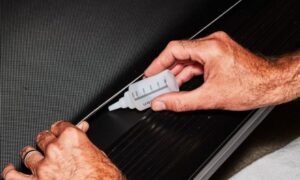
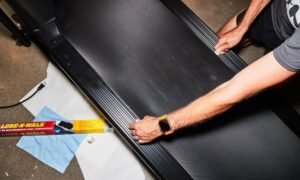
- Lift the belt edge on one side and apply lubricant to the deck surface underneath. Horizon Fitness recommends applying in a zigzag pattern along the center of the deck.
- Do not apply lubricant to the top surface of the belt—the walking surface—as this creates a slip hazard.
- Re-tension the belt if you loosened it, following your manual’s specifications.
- Run the belt at a slow speed—Horizon Fitness advises approximately 3 mph for around 3 minutes—to allow the lubricant to distribute evenly across the deck.
- Check operation by walking on the treadmill at a comfortable speed and noting whether the belt feels smoother and motor noise has reduced.
If you’re unsure about any step, contact your manufacturer’s support line or a qualified treadmill maintenance technician before proceeding.
How Often Should You Lubricate a Running Machine?
There is no single universal lubrication interval. The correct frequency depends on several factors:
- Manufacturer instructions: This is always the starting point. Horizon Fitness, for example, recommends lubrication every 3 months or 150 miles. SOLE Fitness suggests a schedule of every 3–6 months or approximately every 90 hours of use.
- Hours of use and mileage: A treadmill used daily by multiple people needs more frequent attention than one used a few times per week.
- User weight: Heavier users generate more friction per session, which accelerates lubricant breakdown.
- Environment: Treadmills in dusty or low-humidity environments may need lubrication more often.
- Commercial vs. residential use: Commercial treadmills in gyms or facilities typically require more frequent maintenance than home units.
- Deck and belt construction: Some systems are designed to require less frequent lubrication or none at all.
The bottom line: check your manual first, note any manufacturer-recommended intervals, and adjust based on actual usage patterns. Avoid over-application—excess lubricant can migrate onto the belt surface, create slipping hazards, and attract debris that increases wear.
What Are the Signs That a Running Machine May Need Lubrication?
Several symptoms can suggest that lubrication is overdue, though it’s important to recognize that these signs have multiple possible causes:
- Increased friction or resistance underfoot during normal walking or running
- Unusual belt noise, such as a dry scraping or slight squeaking sound during operation
- Rough or jerky belt movement rather than smooth, consistent travel
- A dry or rough feel when you reach under the belt and touch the deck surface
- Sluggish belt response, particularly at lower speeds or under load
None of these symptoms automatically confirm that lubrication is the solution. The same issues can arise from belt tension problems, belt or deck wear, roller wear, or mechanical faults. Lubrication is a reasonable first step when maintenance is overdue, but it shouldn’t be assumed to be the cause without checking other possibilities.
Can Running Machine Lubricant Fix a Slipping Belt?
Not necessarily. A slipping belt is one of the more common treadmill complaints, and while insufficient lubrication can contribute, it’s rarely the only explanation.
A belt slips for several distinct reasons:
- Incorrect belt tension: Too loose, and the belt will slip under load. Too tight, and it creates excessive friction and motor strain.
- Belt misalignment: A belt tracking to one side puts uneven load on the drive system.
- Worn belt or deck: Once the belt underside or deck surface wears past a certain point, no amount of lubricant restores proper function.
- Roller wear: Worn front or rear rollers affect belt grip and tracking.
- Motor or controller issues: A failing motor or drive board can cause belt hesitation that mimics slipping.
Applying lubricant to a belt that’s slipping due to tension, alignment, or mechanical wear won’t fix the problem—and in some cases, it can make the slipping worse. If your belt slips consistently, check tension and alignment first, and consider a professional inspection if the problem persists after basic adjustments. You can find more details on treadmill troubleshooting to help narrow down the cause.
When Lubrication Is Not Enough
Correct lubrication resolves many friction-related issues, but some treadmill symptoms point to problems that no lubricant can fix. If you notice any of the following after performing proper maintenance, the machine likely needs professional inspection:
- A burning smell during or after use, which can indicate motor or belt overheating
- Grinding or rattling sounds that persist after lubrication
- Severe belt hesitation or stopping under normal load
- Belt slipping that continues after correct tension adjustment and lubrication
- Visible belt damage, such as fraying, cracking, or separation
- Unusual motor noise, including buzzing, clicking, or irregular speed changes
- The treadmill stopping unexpectedly mid-session
- Electrical symptoms, including console errors, flickering displays, or power fluctuations
These signs suggest mechanical or electrical faults that require diagnosis beyond routine maintenance. Continuing to run a treadmill with these symptoms can worsen the underlying problem and create safety risks.
If lubrication hasn’t resolved your treadmill’s issues—or if you’re seeing any of the warning signs above—NJ Fitness Equipment Repair can help. Their technicians inspect and service treadmills across New Jersey and New York, identifying the root cause of performance problems before further damage occurs. From treadmill belt and deck inspection to motor diagnostics and fitness equipment repair, their team handles both residential and commercial machines.
Frequently Asked Questions
What is running machine lubricant?
Running machine lubricant is a product applied between a treadmill’s belt and deck to reduce friction during operation. Most treadmills compatible with lubrication require 100% silicone lubricant. It is applied to the underside of the belt along the deck surface and helps protect components, reduce motor strain, and support smooth, quiet operation.
What lubricant should I use on a treadmill?
For most treadmills, 100% silicone treadmill lubricant is the correct choice. However, some models use wax-based systems or proprietary belt and deck combinations that require different products—or no lubrication at all. Always check your owner’s manual before applying any product. For example, Horizon Fitness warns that silicone lubricant must not be used with their Infinity Belt or Infinity Deck systems, as it can increase friction rather than reduce it.
Can I use WD-40 as treadmill lubricant?
No. WD-40 is not a treadmill lubricant. It is a solvent and water-displacement product that can strip existing lubrication, degrade belt materials, and alter belt-deck friction in harmful ways. General household oils are also unsuitable. Always use a product specifically designed for treadmill use, following your manufacturer’s guidance.
How often should I lubricate my running machine?
Lubrication frequency depends on your specific model, usage patterns, user weight, and environment. SOLE Fitness recommends lubrication approximately every 3–6 months or every 90 hours of use as a general guideline. Horizon Fitness recommends every 3 months or 150 miles. These are model-specific figures—your manual’s recommendation takes priority over any general interval.
How much lubricant does a treadmill need?
The amount varies by model, but over-application is a common mistake. Excess lubricant can migrate onto the belt’s walking surface, creating slip hazards, and can also attract dirt that accelerates wear. Follow the quantity specified in your owner’s manual. If no quantity is given, apply a thin, even line or zigzag pattern along the center of the deck rather than saturating the surface.
Can lubricant stop a treadmill belt from slipping?
Sometimes, but not always. Belt slipping can result from insufficient lubrication, but it’s equally common for it to stem from incorrect belt tension, belt misalignment, worn belt or deck surfaces, roller wear, or motor and controller issues. Lubricating a belt that slips due to mechanical faults won’t resolve the problem. If slipping continues after proper lubrication and tension adjustment, a professional inspection is the appropriate next step.
Do all treadmills need lubricant?
No. Some treadmills are designed with maintenance-free or pre-lubricated belt and deck systems that do not require additional lubrication. Applying lubricant to these systems can cause problems rather than prevent them. Checking your owner’s manual is the only reliable way to confirm whether your specific model requires lubrication, which product to use, and how often to apply it.
When should I call a treadmill repair technician?
Call a technician if your treadmill shows signs of mechanical or electrical trouble that lubrication and basic adjustments haven’t resolved. Symptoms that warrant professional inspection include a burning smell during use, grinding or persistent unusual noise, belt slipping that continues after correct tensioning, the treadmill stopping unexpectedly mid-session, visible belt damage, or any electrical issue such as console errors or power fluctuations. NJ Fitness Equipment Repair provides treadmill inspection and repair services across New Jersey and New York and can help identify the underlying problem before it causes further damage.
Keep Your Treadmill Running the Right Way
Running machine lubricant is a small part of treadmill ownership that carries significant consequences when overlooked—or applied incorrectly. The right product, applied properly, at intervals your manufacturer recommends, protects your belt, deck, motor, and drive system from friction-related wear. A dry deck shortens equipment life. But the wrong lubricant, or lubricant applied to a machine that doesn’t need it, creates different problems entirely.
When in doubt, start with your owner’s manual. And when lubrication isn’t enough—when the treadmill keeps slipping, makes unusual sounds, or shows signs of electrical trouble—that’s the point to bring in a professional.
NJ Fitness Equipment Repair offers treadmill maintenance, diagnostics, and repair services for home and commercial equipment across NJ and NY. If your treadmill isn’t performing the way it should, contact their team to schedule an inspection before a minor issue becomes a major repair.